The Confusion About What Tango Actually Is
Before you learn a single step, you need to unlearn what you think Tango is. Here's where every single one of my students starts... when they let me teach them.
Almost everyone who walks into their first Tango class is already confused — and it's not their fault. By the time someone decides to learn Tango, they've usually already met it twice: once in a movie, and once in a performing experience (tango show, competition). Neither one is the dance they're about to learn. The confusion, even among teachers, starts here : Layer one.
Four layers of confusion
Then, as layer two, there's what some people call Ballroom Tango, International or American Style Tango — a dance with structured competitions. This dance — the sharp head snaps, the staccato walks, the fixed pattern of steps performed identically by every couple — is real. It was built for judges, points, and a stage. It's a "filtered" Argentine Tango, not the thing itself: same name, same family, but a different branch, evolved in a different sphere than Argentine Tango.
Let's add another layer (layer three): is Tango actually from Argentina? Yes — it's a real question, officially answered by UNESCO. Tango is a pair dance from Rio de la plata, which means it's from both Argentina and Uruguay. (Unesco Source)
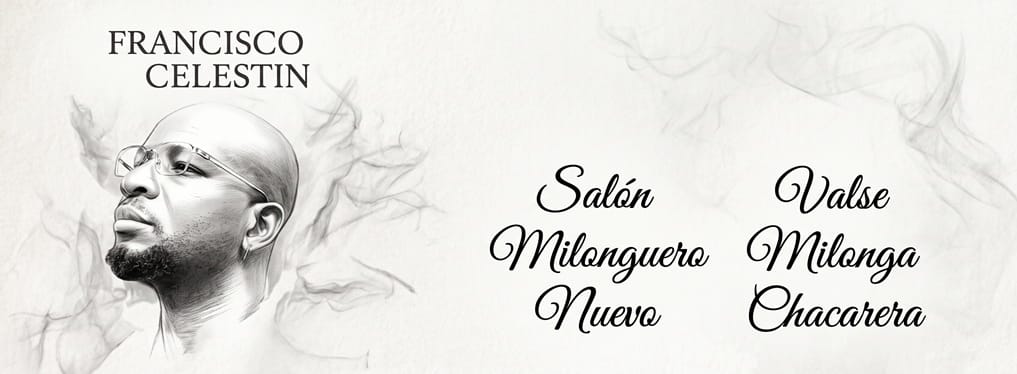
now, If we focus on Argentina Tango (Rio Platense, there's a last but not least layer of confusion (layer four): are you dancing Milonguero, Salón, Nuevo, something else ?
Life becomes beautifully easy when you can identify the friction points born from those four confusions. I am here to clarify all of it and guide you to what is for you.
The Tango I teach
So before we talk about embrace, walking, or musicality, we need to clear the ground. This is where I start with every new student, and it's where you're starting too. I chose to focus on the Tango that matters most to me. I call it Social Tango. We dance it at the milonga (weekly tango event) and at the bal (festival, marathon, monthly bal, encuentro).
Río Platense Social Tango has no fixed pattern. There is no "step 4" that always follows "step 3." Nothing is choreographed. Two people meet, listen to the music (hopefully) together, and build something in real time that will never happen again. That single fact changes everything about how it should be learned — and it's why copying steps from a video will only ever get you so far.
Stage Tango
The other Tango most people have met is stage Tango — the dramatic dips, the high kicks, the tension performed for an audience thirty rows back. It's genuinely beautiful, and it's also Argentina Tango. But it relates to social Tango the way a ballet performance relates to walking down the street (with elegance): technically related, built for completely different purposes. One is designed to be watched. The other is designed to be felt, by exactly one other person. By extension, this dance, created on the spot, can influence the other dancers around. It can also inspire the people watching. But those are not the main goals : just beautiful side effects when they happen.
If you arrive expecting the version from the screen, you'll either be disappointed that your first months don't look like that — or worse, you'll try to force drama and flash into a dance that is actually asking you to do less, not more.
Once more (once less): yes, I can teach Stage Tango (fantasía, escenario), but if I can choose, I will go for Social Tango every single time. It's no less beautiful from the outside, and it provides the kind of food we really need in our societies right now.
Here is a funny thing about my own social Tango :
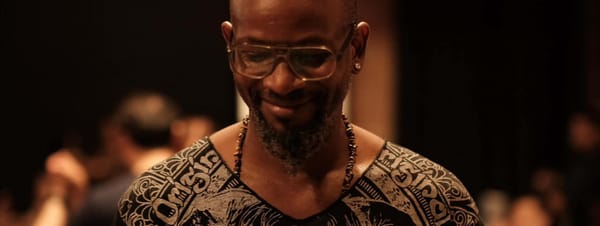
When people see me dance, they often point out that my Tango looks like I'm performing for an audience. I usually tell them to ask my partner how the dance felt for her. Here's the usual feedback:
- First, musicality,
- Second, the quality of the lead.
More experienced dancers will also notice :
- the space management,
- the care given to her axis,
- the flexibility within the lead.
But none of them talk about my stage-Tango style — because they can't really see my Tango, they can mostly feel it, from their own body perspective.
This is where the beauty becomes a three-dimensional sphere: the dancer, the partner and the people around. One or two dimensions are perfectly fine. Three is just a bonus.
So what is it, actually?
Strip away the myths and Rio Platense Tango is built from three things:
- Improvisation: Every dance is a genuine.
- The embrace: Not a pose for the camera, but a movement where the energy flows.
- Walking: Almost everything advanced is a refined version of walking together.
None of this requires athleticism (but it can help), or a "natural gift." It requires a great teacher and a willingness to slow down — which, in my experience, is the most challenging part for someone who wants to learn how to dance better. I often say : " If you want to learn faster, go slower."
Why this matters before anything else
If you skip this and jump straight to steps, you'll spend too much time collecting movements that don't connect to each other, chasing a version of Tango that only exists on a stage or a competition floor (nothing bad about that by the way). If you start here instead — understanding what the dance actually is before trying to do it — everything you learn from that point has a meaning attached to itself. It becomes meaningful. and the brain needs purpose to memorize and remember easily. If we talk about brain science, it's part of the emotional charge helping to have a stronger memory registered.
I often identify a beginner from the embrace, the walk, and the limited "topics of conversation." So, from that statement, you can easily say that a beginner can have 10 years of Tango behind him/her. My 28 years of Tango are only meaningful because of those 2 elements: frequency and purpose.
Where we go from here
Now that we've cleared away what Tango is (and should be for the majority of people going to milongas), the next pieces we'll unpack are the ones that actually build it:
- The embrace as a two-way conversation
- The walking as the most important thing you'll practice
- The music as the 4th "tool" helping the connection
That's the real beginning, in three steps. The acknowledgment of the confusion was just the required doorway to access the proper room.